Howard Gardner is an American psycologist who proposed the
Theory of Multiple Intelligences.
This could be really useful to work with our students. If we
know which is their "dominant" intelligence we will know how do they
learn better.
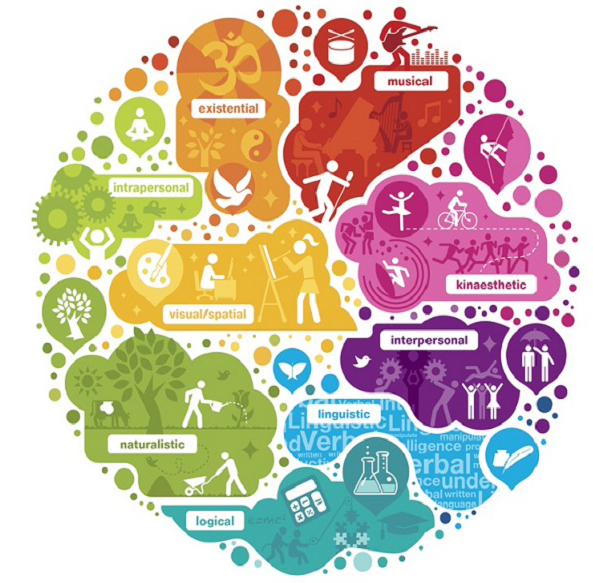
Here you have the main features of each intelligence:
Linguistic Intelligence
 • You love read
and write
• You love read
and write
• You enjoy
with word games.
• You can
remember names and places . . easily.
• You like
listening to stories and tells.
• You have a
lot of vocabulary.
Linguiatic students absorb information by engaging with
reading materials and by discussing and debating ideas.
Logical-mathematical Intelligence
• You like logic
games
• You can
calculate mentally
• You like
abstract ideas, puzzles, playing . chess…
Learn by classifying, categorizing, and thinking abstractly
about patterns, relationships, and numbers.
Musical Intelligence
• You can sing.
• You can
remember sounds, rhythms and melodies
• You work
better when you are listening to music.
They learn using rhythm or melody, especially by singing or
listening to music.
Intrapersonal Intelligence
• You prefer to
work alone.
• You can
motivate yourself.
• You are intuitive
and independent.
• You have a
good self-esteem.
They learn best by working alone and setting individual
goals. Intrapersonal learners are not necessarily shy; they are independent and
organized.
Interpersonal Intelligence
• You are empathic
• You like
working in groups
• You are a
good leader
• You love
social games.
• You can
listen each other.
They learn through relating to others by sharing, comparing,
and cooperating. Interpersonal learners can make excellent group leaders and
team players.
Bodily-kinesthetic Intelligence
• You don’t like
stay quietly.
• You like
sports, dancing or drama.
• You have a
good coordination
• You always
remember corporal sensations
They learn best through touch and movement. These people are
best at processing information through the body. Sometimes kinesthetic learners
work best standing up and moving rather than sitting still.
Spatial Intelligence
• You learn with
images or pictures
• You love
drawing, designing, building…
• You can read
maps and diagrams.
• You love
machines
• You have got
sense of orientation.
They learn best by drawing or visualizing things using the
mind’s eye. Visual people learn the most from pictures, diagrams, and other
visual aids.
Naturalistic Intelligence
• You love nature and enviorement
• You enjoy with open air activities.
• You like collect, classify and read about
nature
Learn by working with nature. Naturalistic students enjoy
learning about living things and natural events. They may excel in the sciences
and be very passionate about environmental issues.
This is a link for a Multiple Intelligences guidance test: Multiple Intelligence test

